Stray Light
Basics
To use ROSALIA, the user will interact with the main class of the package, the rosalia.core.exposure class. This class is defined by the user and it holds all the information about a particular image, including the pointing orientation, the filter, the position angle, the date of the observation, and many other parameters. The rosalia.core.exposure class also contains methods to estimate the stray-light signal in a given exposure, and to correct for it. We describe one example in the next section.
rosalia.core.exposure can be initialized in two ways:
By providing a filename of a fits file with the necessary WCS and header information (filename). In this case, the class will read the fits file and extract the necessary information from the header. This is the most straightforward way to initialize the class, as long as the input fits file has the necessary information in the header.
By providing the custom observer parameters in a dictionary (observer). In this case, the class will use the observer parameters to create a dummy fits file with the necessary WCS and header information. This is useful when the user does not have a fits file with the necessary information, but has the observer parameters. If the observer keyword “TELESCOP” is set to “Roman/WFI”, then the class will create a dummy Roman/WFI fits file with the necessary information. In that case, only needs to contain the name of the telescope (“TELESCOP”), the [ra, dec] coordinates of the pointing (“pointing”), the name of the filter (“FILTER”), the position angle (“PA_Y”), the start time (“EXPSTART”), and the exposure time (“EXPTIME”). For example, the observer dictionary for a simple Roman/WFI observation can be defined as follows:
observer={"TELESCOP": "Roman/WFI",
        "pointing": [ra, dec],
        "FILTER":bandpass,
        "PA_Y": PA,
        "EXPSTART": date.mjd,
        "EXPTIME": exptime}

prefix = "Pleiades"
custom_roman_exposure = rs.core.exposure(observer=observer, prefix=prefix)
straylight_out = custom_roman_exposure.straylight()
We will work to include more telescopes soon (Hubble), but for now, if the observer keyword “TELESCOP” is set to any other value than “Roman/WFI”, then the class will create a generic dummy fits file with the necessary information. The observer dictionary should contain the following parameters:
TELESCOP = "MYTELESCOPE"
INSTRUME = "MYTELESCOPE"
DETECTOR = "MYTELESCOPE"
RA_TARG = 100
DEC_TARG = 23
PA_Y = 32
NAXIS1=3048
NAXIS2=4096
PIXSCALE=8/60/60
R_mirror=1
OBSLOC=273
EXPSTART=61000
EXPTIME=10
FILTER_PARAMS={"NAME": "F606W", "TELESCOPE": "HST", "INSTRUMENT": "ACS", "DETECTOR": "WFC"}

observer = {"TELESCOP":TELESCOP,
            "INSTRUME":INSTRUME,
            "DETECTOR": DETECTOR,
            "pointing": [RA_TARG, DEC_TARG],
            "PA_Y": PA_Y,
            "DATA_SHAPE": [NAXIS1, NAXIS2],
            "PIXSCALE": PIXSCALE,
            "R_mirror": R_mirror,
            "FILTER_PARAMS":FILTER_PARAMS,
            "OBSLOC": OBSLOC,
            "EXPSTART": EXPSTART,
            "EXPTIME": EXPTIME}

custom_exposure = rs.core.exposure(observer=observer)
rosalia.core.exposure accepts any filter supported in the SVO filter system SVO Filter System.
In-field vs. out-field stray-light
Stray-light is the light that reaches the detector without following the nominal optical path. It can be produced by a variety of sources, like bright stars, planets, the Moon, or even the Earth. On first approximation, stray-light can be classified into two main categories: in-field and out-field stray-light. ROSALIA offers tools to estimate both, with a stronger focus on the out-field stray-light, which is the most hard to model.
Quickstart: Out-of-field Stray Light Analysis Example with ROSALIA
The following Jupyter-notebook shows a quick example to estimate stray-light with ROSALIA.
# This notebook demonstrates how to use ROSALIA to analyze stray light in a simple exposure.
import rosalia as rs

# Let's define the minimum parameters to generate a dummy Roman / WFI image
# To get some challenging environment, let's target the Pleiades.
ra = 56.6583333  # Right ascension, in degrees.
dec = +24.1780556 # Declination, in degrees.
PA = 0 # Position angle, in degrees.
from astropy.time import Time
date = Time("2026-12-01T00:00:00") # Date of the observation, in Astropy Time YYYY-MM-DDTHH:MM:SS format.
bandpass = "F129"
exptime = 600 # Exposure time, in seconds.


observer={"TELESCOP": "Roman/WFI",
        "pointing": [ra, dec],
        "FILTER":bandpass,
        "PA_Y": PA,
        "EXPSTART": date.mjd,
        "EXPTIME": exptime}

prefix = "Pleiades"
custom_roman_exposure = rs.core.exposure(observer=observer, prefix=prefix)
straylight_out = custom_roman_exposure.straylight()
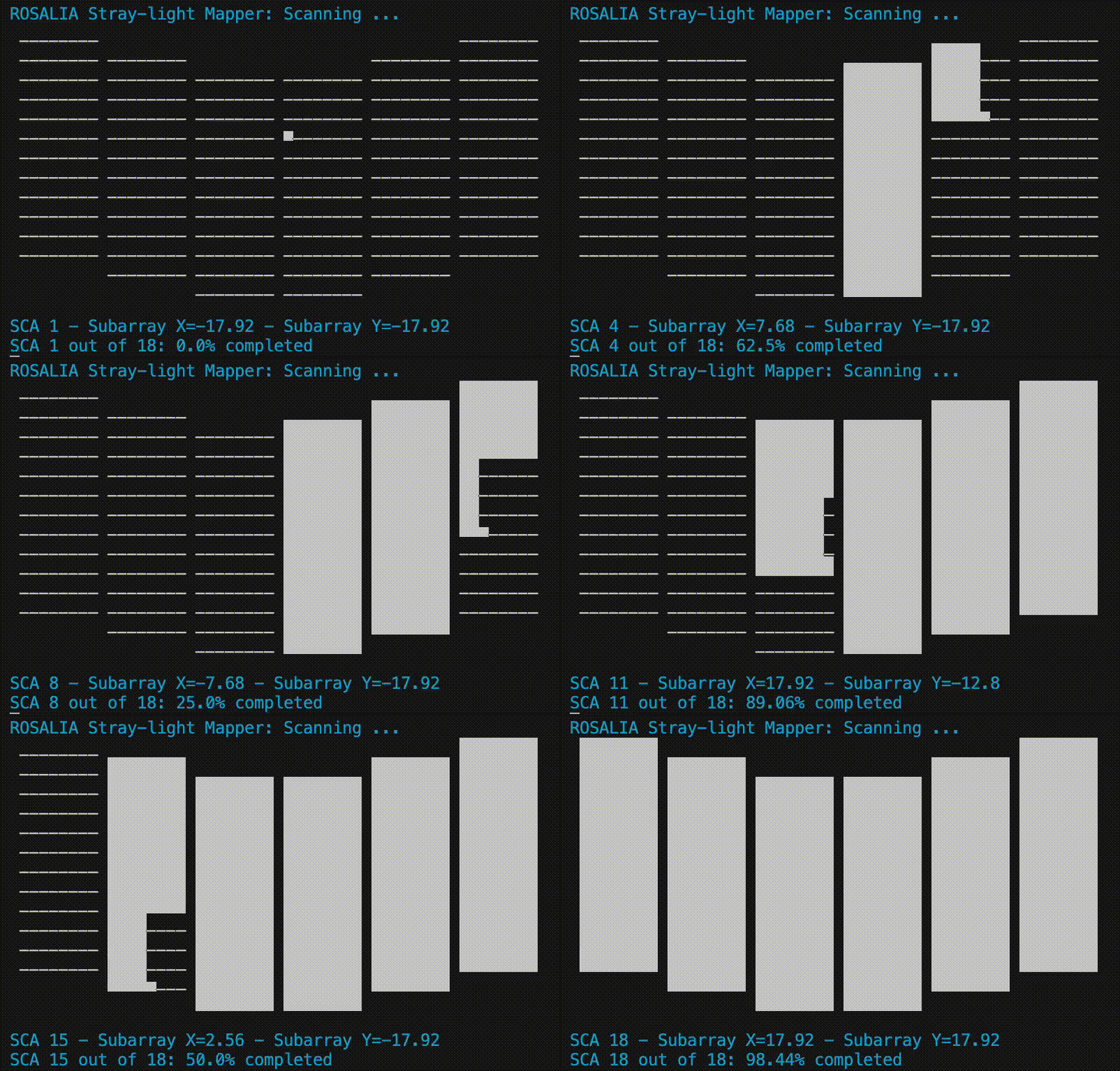
The notebook is available in the notebooks directory of the ROSALIA repository, and can be downloaded from the link below:
* R1_Rosalia_stray_example.ipynb. To run this notebook locally, make sure you have Jupyter installed and then:
Case study: Calibrating stray-light with a bright star
A particular case of interest would be to produce an intense stray-light background signal on purpose, to calibrate the models against real observations. To gather sufficient signal-to-noise and minimize contamination from other background sources like the Zodiacal light, the selected star (offending source) would need to be as bright as possible. In addition, we need to place it in positions around Roman Space Telescope WFI that are known to produce the maximum stray light if hit by a source. With ROSALIA, it is possible to find out where should we point our telescope and which roll (position) angle we should have to maximize or minimize the stray-light from a star.
First, let’s visualize the Normalized Detector Irradiance (NDI) map for Roman Space Telescope Wide Field Instrument.
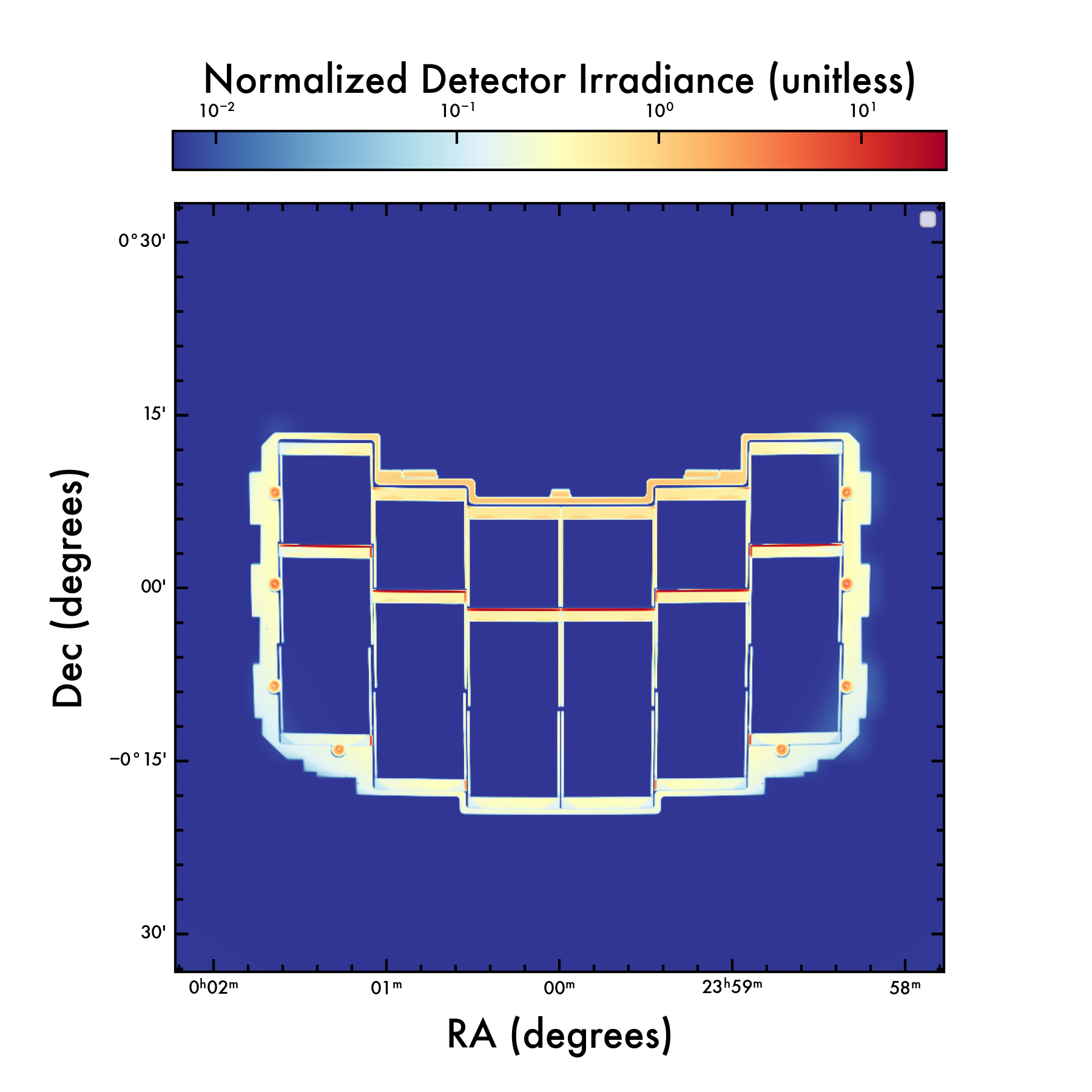
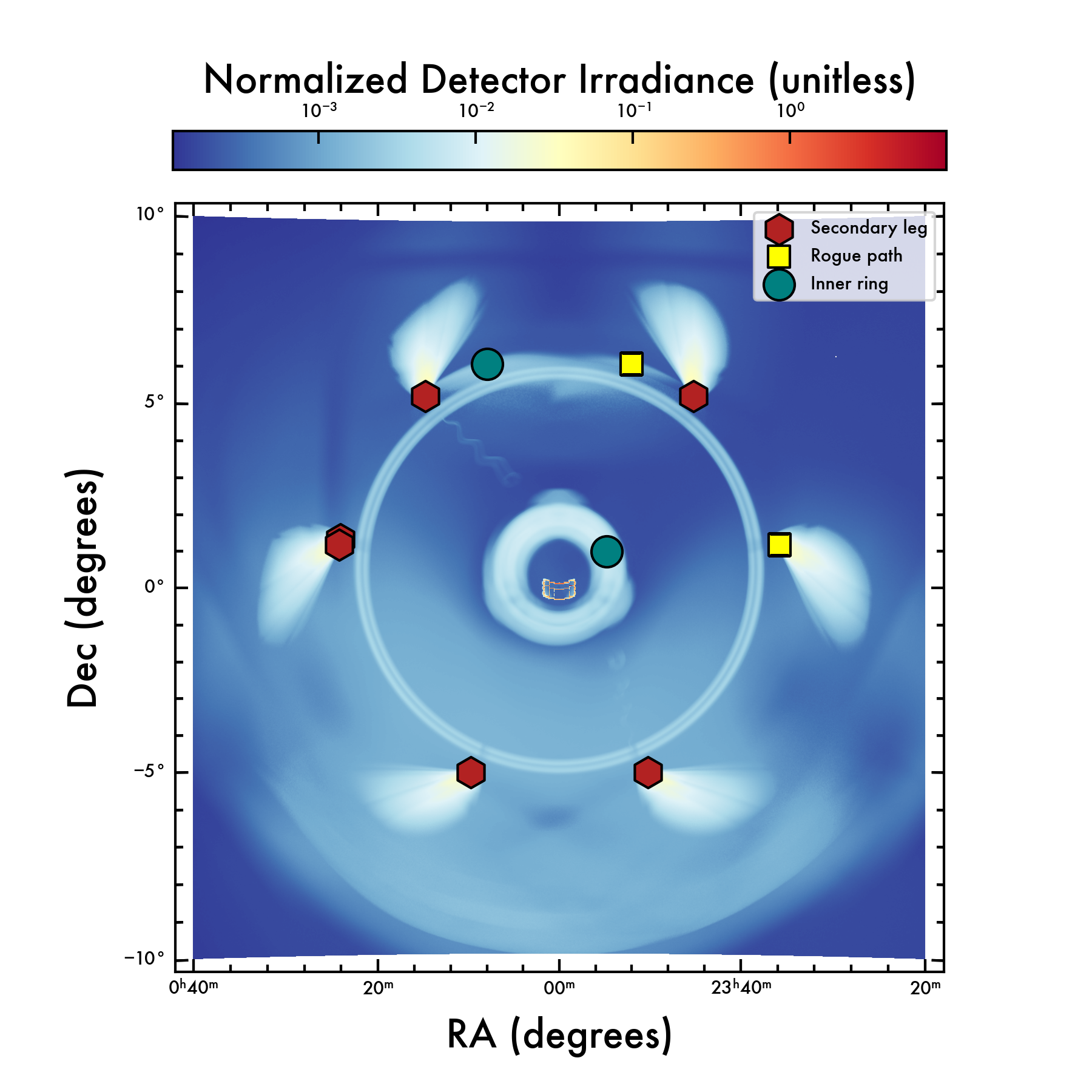
The NDI is defined as the ratio of the stray-light irradiance (power per unit area) received at the detector to the irradiance of the source at the entrance of the telescope (see Bely 2003) . This function can be used to estimate the flux of photoelectrons that an off-axis source will generate in a certain region of the detector. Similarly to the Point Spread Function (PSF) defines the spread of point sources by diffraction effects, the sharpness of the NDI defines the effectiveness of the telescope’s baffling. This function is strongly dependent on the optical setup and wavelength. For a given telescope, the NDI depends on the angular distance between the optical axis and the source, the position angle of the source in the focal plane reference frame, the observation wavelength, and the position on the FOV (x,y),
We can identify several points of interested were stray-light is expected to peak if illuminated:
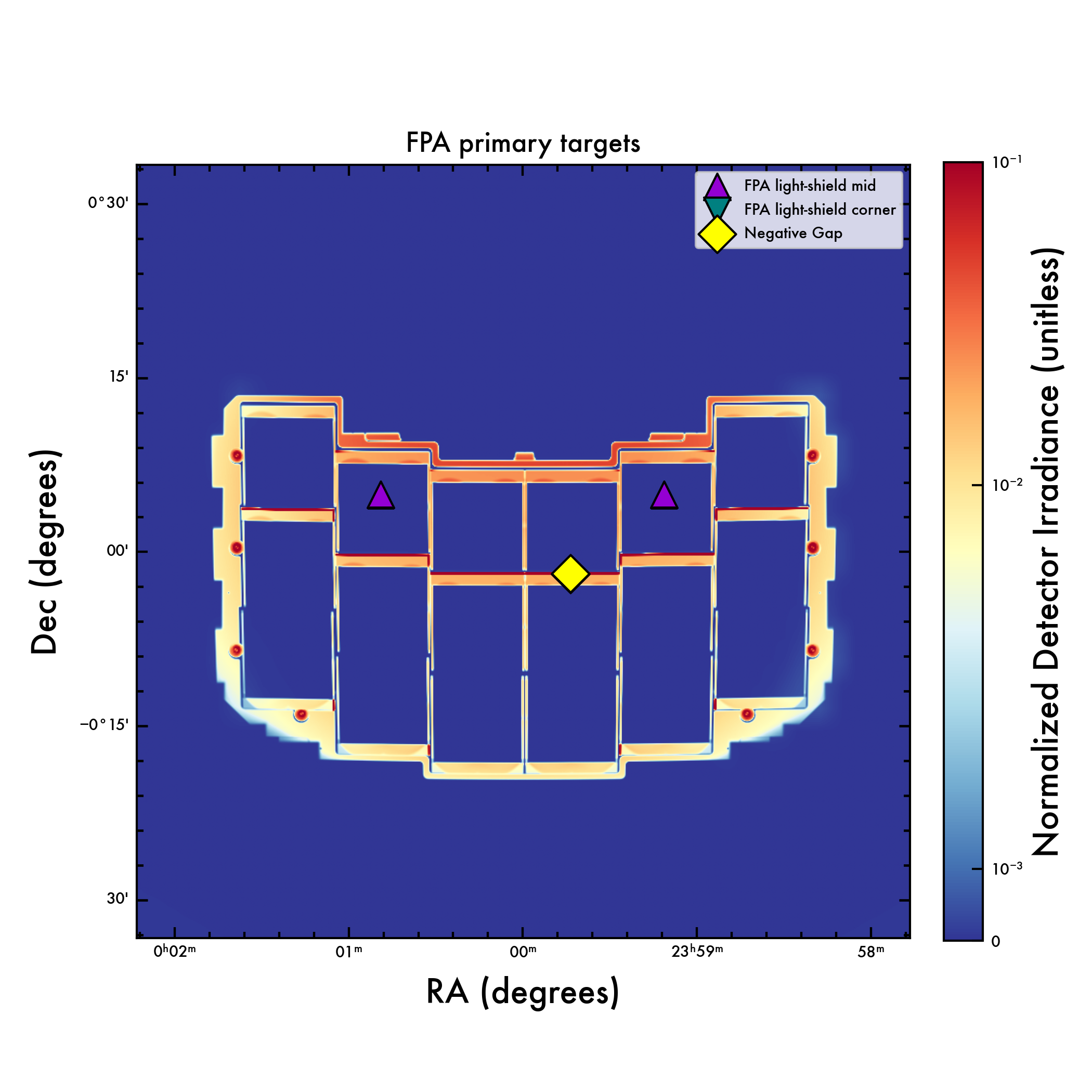
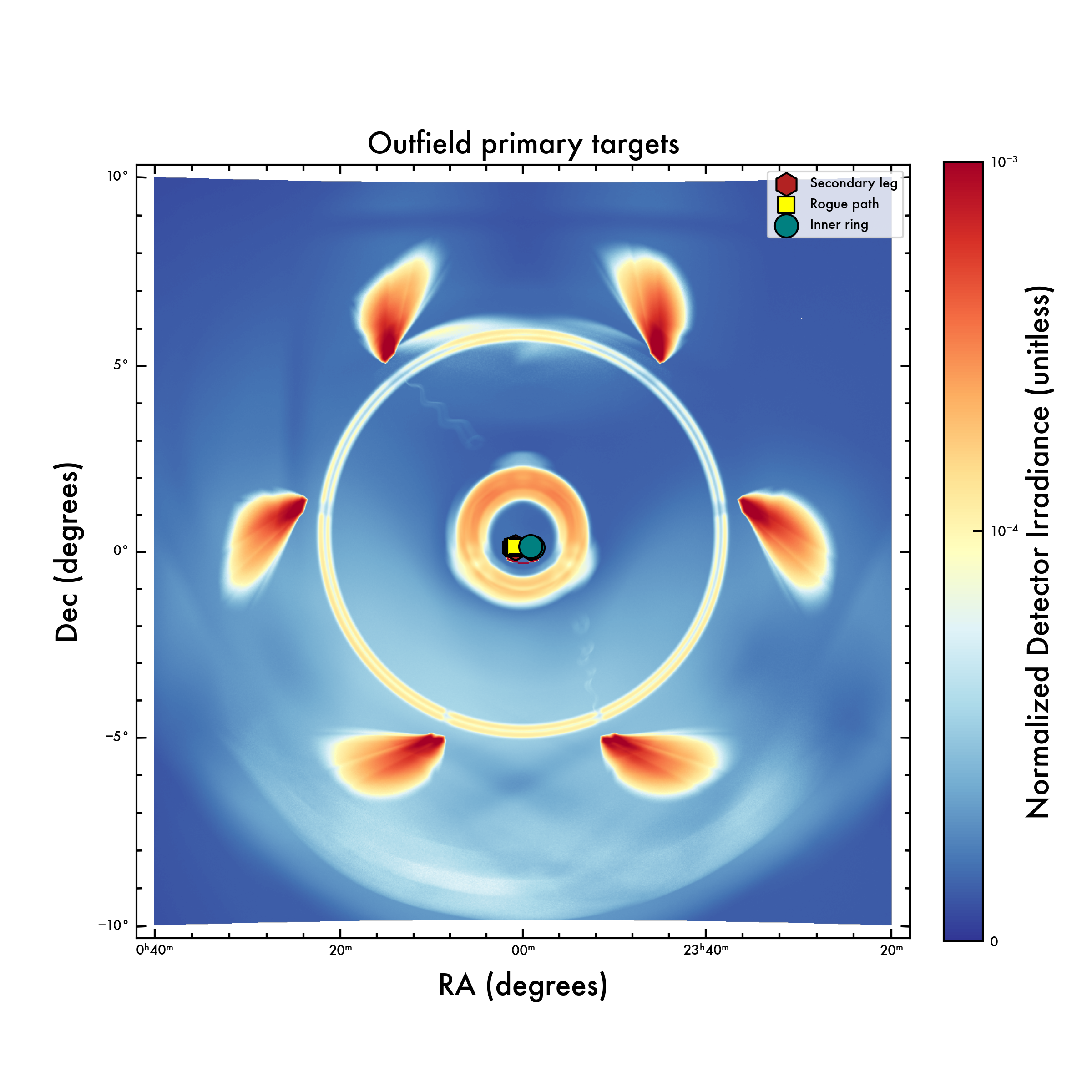
Now that we have found out where which orientations - defined as X and Y angular offsets from the center of the Roman WFI focal plane - should we use to produce stray-light, let’s find out where should we point Roman/WFI to get a particular target oriented to those locations. This can be done using rs.telescopes.Roman.find_wfi_center_for_offset_targets:
# These are the coordinates of specially sensitive locations
# for stray-light, measured in offset degrees from the center of WFI focal plane
dX = np.array([-3.7, 3.7, 6.05, 2.45, -2.45, -6.05, -2, 2, -1.3, 1.3, -0.0688, 0.0688, -0.138, 0.138])
dY = np.array([5.27, 5.27, 1.18, -5.07, -5.07, 1.18, 6.15, 6.15, 1, 1, -0.0312, -0.0312, -0.0035, -0.0048])
number_of_points_of_interest = len(dX)
# To measure the stray-light from those sources, we need to place the center
# of Roman / WFI at a certain distance and position angle from the source
# that generates the stray-light. We will name that source the "offending" source.

# ROSALIA has a specific tool to compute those locations.

# The optimal position angle of Roman depends with time.
# Let's set an approximate time for the Commissioning Activities
from astropy.time import Time
date = Time('2026-11-21T00:00:00.0', format='isot', scale='utc')

ra_wfi = np.zeros(number_of_points_of_interest)
dec_wfi = np.zeros(number_of_points_of_interest)
pa_wfi = np.zeros(number_of_points_of_interest)

for i in range(number_of_points_of_interest):
    offset_pointing = rs.telescopes.Roman.find_wfi_center_for_offset_target(ra_target=target.ra.degree,
                                                      dec_target=target.dec.degree,
                                                      mjd=date.mjd,
                                                      dX=dX[i], dY=dY[i])
    ra_wfi[i] = offset_pointing["ra_wficen"]
    dec_wfi[i] = offset_pointing["dec_wficen"]
    pa_wfi[i] = offset_pointing["pa_wfi"]
Now that we have the exposure parameters for WFI, we only need to simulate the stray-light with rosalia_stray:
for i in range(number_of_points_of_interest):
    ra = ra_wfi[i]
    dec = dec_wfi[i]
    pa = pa_wfi[i]
    mjd = mjd
    bandpass="F129"
    exptime=600
    rosalia_stray = rs.correct.rosalia_stray(ra=ra, dec=dec,
                                             PA=pa, date=date, bandpass=bandpass,
                                             exptime=exptime, radius=1,
                                             g_mag_max=15)
The following Jupyter-notebook shows an example of how to do that with ROSALIA. The notebook is available in the notebooks directory of the ROSALIA repository, and can be downloaded from the link below: